Preventative Car Maintenance Checklist 2026
Table of Contents
Last Updated: October 12, 2026
Why Preventative Car Maintenance Matters in 2026
A preventative car maintenance checklist is a scheduled set of inspections and service tasks that keeps a vehicle safe, reliable, and affordable to own. At Old Town Tire & Automotive, we have watched this simple habit separate cars that reach 200,000 miles from those that need major repairs at 90,000. A 2026 preventative car maintenance checklist protects your investment, catches small problems before they become expensive ones, and keeps you safer on the road.
Key Takeaway The cheapest repair is the one you never need. Routine service costs far less than the breakdown it prevents.
Your Vehicle Maintenance Schedule: Start With the Owner's Manual
The owner's manual is the single most reliable source for your vehicle maintenance schedule, and most drivers never open it.
Every automaker publishes a service interval chart built for that specific engine, transmission, and drivetrain. Generic advice online cannot match it.
Standard schedule: often 7,500 to 10,000 miles between oil changes
Severe-duty schedule: sometimes 5,000 miles or less
Time-based items: brake fluid and coolant often have year limits even at low mileage
A common mistake is following the "lifetime fluid" label on a transmission. In practice, "lifetime" usually means the warranty period, not the life of the car.
The Preventative Car Maintenance Checklist by Mileage
Mileage intervals give you a practical framework when the manual is unclear or you have lost track of service history. Use them as a default, then adjust using the method below.

How to Adapt Any Interval to Your Vehicle
A general checklist is a starting point, not a schedule. To make it vehicle-specific, work through four inputs:
Owner's manual service chart. Find the chart for your exact engine and drivetrain. The same model year can carry different intervals for a turbocharged four-cylinder versus a V6, or for all-wheel drive versus front-wheel drive.
Severe-duty definition in your manual. Most manuals list which conditions trigger the shorter schedule. Common triggers: trips under about 5 miles, stop-and-go traffic, towing, roof-load carrying, dusty or salted roads, and sustained temperatures below freezing or above roughly 90°F.
Your actual driving mix. If most of your weekly miles are short errands, you are likely on the severe-duty schedule even if you never tow anything.
Time-based items. Brake fluid, coolant, and some transmission fluids carry year limits regardless of mileage. A low-mileage car can still be overdue.
Write the resulting intervals into a log with date, odometer reading, service performed, and next-due mileage or date. That single habit turns a generic checklist into a schedule you can actually follow.
Every 5,000 to 7,500 Miles
Change engine oil and oil filter (many modern engines specify 7,500 to 10,000 miles on the standard schedule; severe duty often drops this to 5,000 or less)
Rotate tires and set tire pressure to the door-jamb placard, not the tire sidewall maximum
Inspect brake pads and check brake fluid level
Check coolant level, washer fluid, and all exterior lights
Test the battery and clean terminals
Every 15,000 to 30,000 Miles
Replace the engine air filter and cabin air filter
Inspect brake pads and rotors for wear and scoring
Check wheel alignment and measure tire tread depth
Replace wiper blades and inspect suspension components (struts, shocks, bushings, tie rods)
Flush brake fluid and inspect the cooling system, belts, and hoses
Every 30,000 to 60,000 Miles
Replace spark plugs on the interval your manual specifies (many engines now call for 60,000 to 100,000 miles; older or turbocharged engines often need them sooner)
Service the transmission per the manual, ignoring "lifetime fluid" labels, in practice, "lifetime" usually means the warranty period, not the life of the car
Replace the engine coolant at the manufacturer's interval
Inspect the serpentine belt, hoses, and battery hold-down
Check brake calipers, parking brake, and exhaust hangers
Every 60,000 to 100,000 Miles
Replace the timing belt if your engine uses one (many modern engines use a chain, which has no fixed replacement interval but should be inspected for noise)
Replace the water pump if it is driven by the timing belt
Service the differential and transfer case on all-wheel-drive and four-wheel-drive vehicles
Inspect and replace worn suspension components
Replace the battery if it is more than three to five years old, or sooner if testing shows reduced capacity
What Changes on Hybrids and EVs
Hybrids and EVs drop oil and filter changes but keep most safety inspections. Regenerative braking reduces brake pad wear, yet brake fluid still absorbs moisture and needs periodic replacement. Tire rotation and pressure checks matter even more because instant torque wears tires faster. The high-voltage battery and its cooling system require specialized diagnostic tools and training, so confirm a shop is equipped before you book.
Key Takeaway Mileage is a default, not a diagnosis. The manual's severe-duty section plus your actual driving mix is what turns a generic interval into a schedule that protects your vehicle.
These mileage intervals are a starting point, not a rule. Severe-duty driving conditions, heavy towing, and short city trips can compress every one of them.
DIY Car Maintenance Checklist: What You Can Handle at Home
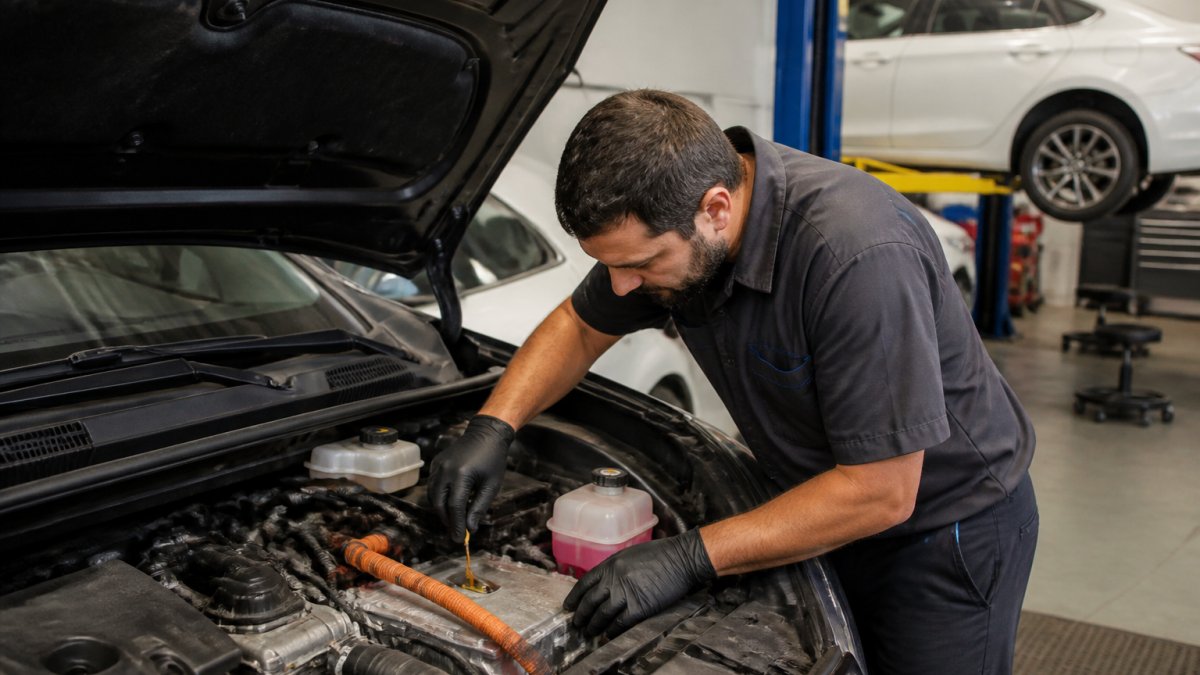
A DIY car maintenance checklist covers the tasks most owners can safely handle with basic tools: checking oil, topping off fluids, testing tire pressure, replacing wiper blades, and swapping air and cabin filters.
What you should not attempt at home: brake replacement, coolant flushes, suspension work, or anything requiring a lift. These jobs involve safety-critical systems and torque specifications that demand proper equipment.
Watch Out Never crawl under a car supported only by a jack. Use jack stands on level ground every time. A jack failure is fatal, not inconvenient.
Severe-Duty Driving and Seasonal Maintenance
Severe-duty driving conditions shorten every service interval, and most drivers underestimate whether they qualify. Stop-and-go traffic, dusty roads, extreme heat, towing, and short trips that never let the engine warm up all count as severe duty.
Seasonal maintenance matters just as much. Before winter, check battery health, tire tread depth, and washer fluid rated for freezing temperatures. Before summer, inspect coolant, belts, and hoses, since heat stress is the leading cause of roadside breakdowns.
Hybrid and Electric Vehicle Maintenance: What Changes
Hybrid and electric vehicle maintenance drops the oil change but keeps most safety inspections. Regenerative braking reduces brake pad wear, yet brake fluid still absorbs moisture and needs periodic replacement. Tire rotation and tire pressure checks matter even more, because instant torque wears tires faster.
The high-voltage battery and cooling systems require specialized diagnostic tools and training. Not every shop is equipped for this work, so confirm before you book.
Car Maintenance Costs and How to Prioritize Repairs
Car maintenance costs vary widely by vehicle, region, and shop, so we always recommend asking for a written estimate rather than a ballpark figure. Prioritize repairs in this order:
Priority | Item | Why It Comes First |
1 | Brakes and tires | Direct safety impact |
2 | Battery and starting | Stranding risk |
3 | Fluid leaks | Prevents engine damage |
4 | Filters and wipers | Low cost, high payoff |
5 | Cosmetic items | Deferrable |
When money is tight, handle safety-critical items first and schedule the rest. Skipping a brake inspection to save money rarely works out.
Warning Signs You Should Never Ignore
Certain warning signs mean stop driving and get the vehicle inspected immediately. Others mean schedule service soon. Knowing which is which prevents both panic and costly delay.
Stop Driving Now
Brake pedal that sinks to the floor or feels spongy. Likely a hydraulic leak or air in the system. Do not drive.
Grinding brakes. Metal-on-metal contact means the pad is gone and the rotor is being destroyed.
Steering that pulls hard or vibrates violently. Could be a failing tire, wheel, or suspension component.
Smoke from under the hood or a burning smell. Shut off the engine and get clear of the vehicle.
Temperature warning light or gauge in the red. Continuing to drive can warp the cylinder head.
Schedule Service This Week
Check-engine light, steady. Often emissions-related, but do not ignore it, a misfire can damage the catalytic converter.
Slow cranking or dimming lights. The battery or charging system is failing. Test it before it strands you.
Squealing brakes. Wear indicators are telling you the pads are near the end of their life.
Vibration through the steering wheel at highway speed. Commonly a wheel balance or alignment issue, sometimes a tire defect.
Uneven tire wear. Points to alignment, inflation, or suspension problems.
Track It, Don't Guess
A preventative car maintenance checklist is only as good as your follow-through. Keep a log, paper or app, with the date, odometer reading, service performed, and next-due interval. Photograph your dashboard warning lights and any fluid leaks before you arrive at the shop. That gives the technician a faster starting point and helps you describe the problem accurately. Keep your maintenance records for resale value; a documented history is one of the few things a buyer can verify.
Watch Out A warning light is not a suggestion. If the brake or temperature light comes on, pull over safely and stop driving. The cost of a tow is almost always less than the cost of the damage that follows.
Pro Tip Photograph your dashboard warning lights and any fluid leaks before you arrive at the shop. It gives the technician a faster starting point and helps you describe the problem accurately.
Frequently Asked Questions
What is the most common preventative maintenance done on a car?
Oil and filter changes top the list. Engine oil breaks down over time and collects contaminants, so most owner's manuals call for a change somewhere between 5,000 and 7,500 miles, though severe-duty driving can shorten that interval. Tire rotations and pressure checks come next, since they protect tread life and fuel economy. Brake inspections, fluid level checks, and battery testing round out the services shops perform most often during a routine preventative car maintenance visit.
What should be included in a car maintenance checklist?
A complete checklist covers oil and filter changes, tire pressure, tread depth and rotation, coolant and washer fluid levels, brake pad and rotor inspection, battery health, air filter replacement, and all lights including headlights, turn signals, and brake lights. Add wiper blades, suspension checks, and a look for leaks. Following a vehicle maintenance schedule from your owner's manual keeps these items on track instead of reacting to breakdowns after they happen.
What car maintenance should be done by mileage?
At 5,000 to 7,500 miles, plan oil and filter changes plus tire rotation. Around 15,000 to 30,000 miles, replace the engine air filter, inspect brakes, and check coolant. At 30,000 miles and beyond, many manufacturers call for spark plugs, transmission fluid, and a full inspection of belts and hoses. A car maintenance checklist by mileage gives you a clear timeline, but your owner's manual always takes priority over generic intervals.
Which car maintenance tasks can I do myself?
A DIY car maintenance checklist can safely include checking tire pressure, topping off washer fluid, inspecting wiper blades, testing lights, and checking coolant and oil levels. Replacing an air filter is also manageable for most owners. Brake work, fluid flushes, and anything requiring the vehicle to be lifted should go to a shop. If you are unsure whether a task is safe without a lift or proper tools, have a certified technician handle it.
How do I keep track of car maintenance costs?
Keep a folder or digital log of every receipt, mileage reading, and service performed. This record helps you spot patterns, plan for upcoming expenses, and show a complete history if you sell the vehicle. Car maintenance costs vary by make, model, and driving conditions, so ask your shop for a written estimate before work begins.
How often should I service my car if I drive in stop-and-go traffic?
Stop-and-go commuting counts as severe-duty driving, which shortens many service intervals. Oil changes may be needed closer to 5,000 miles instead of 7,500, and brakes wear faster because of constant braking. Tire rotation intervals stay similar, but pressure checks should happen monthly. Check your owner's manual for the severe-duty schedule and follow it rather than the standard one if most of your driving is city traffic.
Managing a preventative car maintenance checklist on your own is doable, but the safety-critical inspections still need a trained eye and proper equipment. At Old Town Tire & Automotive, our master ASE-certified technicians service all makes and models, including hybrid and diesel vehicles, with over 20 years of experience and secure night drop-off for after-hours service. Request an appointment today and let our family-owned team keep your vehicle reliable for the long haul.