

Expert Diesel Engine Repair: Albuquerque Owner's Guide
Table of Contents
What Expert Diesel Engine Repair in Albuquerque Actually Involves
Diesel Engine Warning Signs That Warrant Immediate Attention
Symptoms You Should Never Drive On
Diesel Engine Diagnostics: What Happens After You Drop Off the Keys
Cummins, Duramax, and Power Stroke: Platform-Specific Service Notes
Cummins (Ram 2500/3500, 5.9L and 6.7L)
Duramax (GM 2500/3500, 6.6L)
Power Stroke (Ford F-250/F-350, 6.0L, 6.4L, 6.7L)
Why Platform Knowledge Changes the Estimate
Diesel Engine Maintenance: The Schedule That Prevents Breakdowns
Diesel Engine Repair Cost: What Drives Your Estimate Up or Down
How a Diesel Repair Estimate Is Actually Built
The Factors That Move the Number
What a Written Estimate Should Include
What Would Make This Cost More
How to Choose a Diesel Repair Shop You Can Trust
Credentials, Warranties, and Repair-Quality Verification
Frequently Asked Questions
Last Updated: October 5, 2026
What Expert Diesel Engine Repair in Albuquerque Actually Involves
Expert diesel engine repair means diagnosing the actual failure, repairing only what is worn or broken, and verifying the fix under real load before the truck goes back on the road. At Old Town Tire & Automotive, our master ASE-certified technicians have handled diesel service for over 20 years.
A diesel engine is a high-pressure system: injectors fire at extreme pressures, the turbocharger spins fast, and emissions hardware punishes neglect.
This guide covers what expert diesel engine repair in Albuquerque involves, from warning signs to diagnostics, maintenance, and estimate factors.
Key Takeaway Expert diesel repair is a diagnostic discipline, not a parts-swapping exercise. The shop that finds the root cause first usually saves you money, even if its hourly rate is higher.
Diesel Engine Warning Signs That Warrant Immediate Attention
Some diesel symptoms are warnings; others are emergencies. The difference is whether the engine is still protecting itself or already damaging components.
Watch for these signals:
Check engine light, solid: Get it scanned soon, a stored code is cheap to read and often cheap to fix now.
Check engine light, flashing: Stop driving. Active misfire can dump raw fuel into the exhaust and destroy emissions components.
Loss of power under load: Often boost, fuel delivery, or turbocharger trouble. Ignoring it makes the repair bigger.
Symptoms You Should Never Drive On
Flashing check engine light, temperature climbing past normal, engine knocking or rattling, or sudden loss of oil pressure. Any of these can turn a repair into a replacement, have the vehicle towed.
Watch Out Driving on a flashing check engine light is one of the most expensive mistakes diesel owners make. Raw fuel entering the exhaust can destroy the diesel particulate filter, turning a few-hundred-dollar repair into a four-figure one.
Diesel Engine Diagnostics: What Happens After You Drop Off the Keys
Diagnostics means reading fault codes, testing live sensor data, and confirming the failure with physical inspection before ordering parts. A code tells you where the computer noticed a problem, not what part to replace.
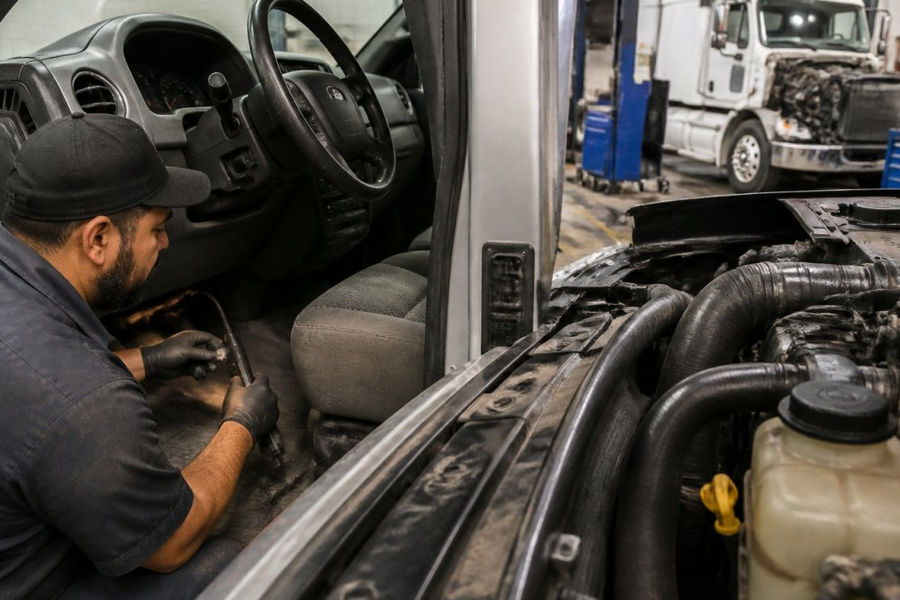
Here is what a proper diagnostic process looks like:
Scan for fault codes across all modules, including stored and pending codes.
Review freeze-frame data to see the conditions when the fault set.
Test live data on fuel pressure, boost, and sensors while the engine runs.
Inspect the suspect system physically for leaks, wear, and wiring issues.
Confirm the diagnosis before quoting the repair.
What most guides miss is that a fault code is a starting point, not an answer. The EPA guidance on diesel emissions and service matters here too, because emissions-related faults have to be repaired correctly, not deleted.
Pro Tip Ask the shop to explain what test confirmed the diagnosis, not just what part they plan to replace. A shop that can walk you through the test is usually a shop that found the real problem.
Cummins, Duramax, and Power Stroke: Platform-Specific Service Notes
Each major diesel platform has known weak points, and a good shop adjusts its checklist accordingly. The three you will see most in this area are the Cummins inline-six in Ram trucks, the Duramax V8 in GM trucks, and the Power Stroke V8 in Ford trucks. Knowing what fails first shortens diagnostics and keeps small repairs from becoming large ones.
Cummins (Ram 2500/3500, 5.9L and 6.7L)
The 5.9L Cummins is long-lived, but the fuel system is where owners spend money; the 6.7L added emissions hardware with its own wear items. Common focus areas:
Injector wear and return-flow imbalance, a worn injector can over-fuel one cylinder, washing the cylinder wall and diluting the oil.
Lift pump and injection pump health, low fuel pressure starves the injection pump, and the injection pump is the expensive part.
EGR cooler and DPF loading on 6.7L trucks used for short trips, where the engine never reaches the temperature needed to burn off soot.
A useful question to ask: How do you test injector health, return-flow test, cylinder contribution test, or both? A shop that only reads codes is guessing.
Duramax (GM 2500/3500, 6.6L)
The Duramax is strong, but fuel and emissions systems are the usual suspects. Common focus areas:
CP4 fuel pump failure on later models, when it fails, it sends metal debris through the entire fuel system, which is why catching low fuel pressure early matters.
Fuel filter housing leaks and air intrusion, air in the fuel system causes hard starts and rough running.
Glow plug and glow plug control module faults, a common cause of cold-start complaints.
A useful question to ask: Do you pressure-test the fuel system before replacing parts? Air intrusion and pressure loss are different problems with different fixes.
Power Stroke (Ford F-250/F-350, 6.0L, 6.4L, 6.7L)
The Power Stroke family spans very different engines, so the service approach changes by generation. Common focus areas:
6.0L: EGR cooler and oil cooler, a clogged oil cooler starves the EGR cooler, and the EGR cooler then fails. They are usually replaced together.
6.0L: head studs and head gasket, high cylinder pressure lifts the factory head bolts; upgraded studs are a common fix.
6.4L: fuel system and turbo, the compound turbo setup and high-pressure fuel system are the frequent repair points.
A useful question to ask: What is your diagnostic sequence for a no-start or low-power complaint? The answer tells you whether the shop works from symptoms or from a checklist.
Why Platform Knowledge Changes the Estimate
A shop that works across all three platforms sees patterns a single-brand shop misses. That changes three things:
What gets inspected first, the technician goes straight to the likely failure.
What gets quoted, known failure patterns come with known parts and labor ranges.
What gets caught early, a return-flow test on a Cummins or fuel-pressure test on a Duramax can catch a problem before it damages downstream components.
Platform | Common Focus Areas | What to Ask |
Cummins | Injectors, lift pump, EGR cooler, turbo actuator | How do you test injector health? |
Duramax | CP4 pump, fuel filter housing, glow plugs, cooling | Do you pressure-test before replacing? |
Power Stroke | EGR/oil cooler, head studs, turbo, fuel system | What's your diagnostic sequence? |
Pro Tip When you call a shop, name your engine and generation (for example, "6.0L Power Stroke" or "6.7L Cummins"). A shop that immediately knows the common failure points for that specific engine is a shop that has worked on it before.
Diesel Engine Maintenance: The Schedule That Prevents Breakdowns
Preventive maintenance is the cheapest diesel engine repair you will ever buy. Most breakdowns trace back to a missed interval, not a sudden failure.
A practical maintenance schedule includes:
Oil and filter changes at the manufacturer's interval, shortened for heavy towing or dusty conditions.
Fuel filter replacement on schedule. Diesel fuel systems are unforgiving about contamination.
Cooling system service to protect against overheating and cavitation.
In practice, the owner who follows the schedule spends far less over five years than the owner who waits for a warning light.
Diesel Engine Repair Cost: What Drives Your Estimate Up or Down
Most diesel repair pages avoid pricing, leaving owners guessing. We will not publish flat prices, because a diagnosis has to happen before an honest number exists, but we can explain how an estimate is built.
How a Diesel Repair Estimate Is Actually Built
A written estimate is three numbers added together, plus a contingency:
Diagnostic time, hours to scan, test, and confirm the failure, billed whether or not you approve the repair.
Labor hours, the manufacturer's flat-rate time, adjusted for access difficulty.
Parts cost, replacement components plus fluids, gaskets, and fasteners.
Contingency, a line for what might be found once the engine is opened. A good shop states this openly.
The Factors That Move the Number
Parts versus labor split. Some failures are labor-heavy (head gasket), others parts-heavy (injectors). Knowing which tells you where the money goes.
Access difficulty. Cab-off service on a Ford or turbo removal on a Duramax takes more hours than an accessible component, often the biggest swing factor.
Damage spread. A caught-early injector is a few hundred dollars; left until it washes a cylinder wall, it is an engine-out job.
What a Written Estimate Should Include
Ask for an estimate that separates these line items:
Diagnostic time, stated separately from repair labor
Labor hours and the flat-rate source
Parts list with OEM or aftermarket designation
What Would Make This Cost More
The most useful question about a diesel repair estimate is not "how much" but "what would make this cost more." A shop that answers clearly plans to be honest. Common answers:
A second failure found during teardown, for example, a worn turbo found while replacing an exhaust manifold gasket.
Fasteners that break during removal, common on high-mileage exhaust and turbo hardware.
Machine work, resurfacing a head or honing a cylinder is outsourced and adds time.
Key Takeaway A transparent estimate separates diagnostic time, labor, and parts, and states up front what could change the number. If a shop will not put that in writing, that is your answer.
For current pricing on your specific vehicle and engine, contact us with your year, make, model, and engine size, and we will walk you through what a diagnosis and repair would involve.
How to Choose a Diesel Repair Shop You Can Trust
Finding a shop you trust means verifying credentials, understanding the diagnostic process, and confirming the warranty in writing before handing over the keys.
Use this checklist:
Confirm ASE certification for the technicians who will work on your truck.
Ask how the shop diagnoses before it quotes.
Request a written estimate that separates parts and labor.
Credentials, Warranties, and Repair-Quality Verification
Credentials are verifiable. Ask to see certification, ask about warranty terms, and ask how the shop handles a repair that does not solve the problem. A trustworthy shop answers all three without hesitation.
Old Town Tire & Automotive is a family-owned shop and an AAA Approved Repair Shop, and our technicians are master ASE certified. You can verify ASE certification through the official ASE directory before you book.
Frequently Asked Questions
How do I choose a reliable diesel engine repair shop?
Start with credentials you can verify: ASE certification, AAA Approved Repair Shop status, and a track record of diesel-specific work. Ask whether the shop has the necessary scan tools for Cummins, Duramax, and Power Stroke platforms, since generic code readers miss crucial diagnostic data. Request a written estimate before work begins, confirm the warranty terms in writing, and check recent reviews for how the shop handles problems after the repair. A shop that explains the diagnostic process up front is usually the one that stands behind its work.
What are the signs that a diesel engine needs professional repair?
Watch for a check engine light, loss of power under load, excessive black or white smoke, rough idle, hard starting, and rising coolant or oil consumption. Overheating, a fuel smell, or a turbo whine that changes pitch also point to problems that get more expensive the longer you wait. Any symptom that appears together with a warning light deserves a diagnostic appointment rather than continued driving, because fuel system and emissions components on a diesel can fail in sequence.
What does a diesel engine diagnostic include?
A proper diagnostic starts with pulling stored fault codes, then verifying them against live data: injector balance rates, rail pressure, turbo boost, EGT, and regeneration history. The technician should also perform a visual inspection of the fuel system, cooling system, exhaust system, and look for leaks or chafed wiring. You should receive an explanation of what was tested, what the readings showed, and which repairs are needed now versus which can wait. Ask for that in writing so you can compare it later.
How much does diesel engine repair typically cost?
Repair cost depends on the failed component, the engine platform, and how much labor the job requires. A sensor or injector replacement sits at one end of the range; turbo replacement, head gasket work, or an engine overhaul sits at the other. Parts availability for Cummins, Duramax, and Power Stroke engines also affects the total. Because pricing varies that widely, ask the shop for a written estimate that separates parts and labor, and confirm whether the diagnostic fee is credited toward the repair.
Diesel repair gets expensive fast when the wrong part gets replaced first. The fix is a shop that diagnoses before it quotes, explains what it found, and stands behind the work. Old Town Tire & Automotive brings more than 20 years of experience, master ASE-certified technicians, AAA Approved Repair Shop status, and honest, professional care for every vehicle to every job. Request an appointment with Old Town Tire & Automotive and get your diesel diagnosed right the first time.
Request Appointment


